All those involved in tunnel construction know that once the rock layer hardness kicks in, tunneling feels like a snail's pace. The traditional drilling and blasting method requires blasting qualifications and waits for the blasting time; the hydraulic breaker for hard rock has too low efficiency, and the drill head needs to be replaced several times a day. Have you ever been worried: the project schedule is stuck, mechanical wear is high, and the oil money is flowing like a river. The pain points in this industry boil down to three words: hard, slow, and expensive. The Anneng railway tunnel impact Milling Machine is specifically designed to deal with such hard rock. It integrates a high-frequency impact hammer and milling drum into one, impacting to crack the rock surface while rotating to cut and peel off, working in tandem. No matter how hard the surrounding rock is, it can't withstand it. The equipment can be directly installed on an excavator, and there's no need for additional trailers for relocation; it can start working as soon as it arrives. Feedback from users who have used it indicates that previously, it took half a day to blast a certain volume of rock, but now it can finish it in two hours, with significantly less noise and dust, and no need to stop to ventilate and disperse smoke. 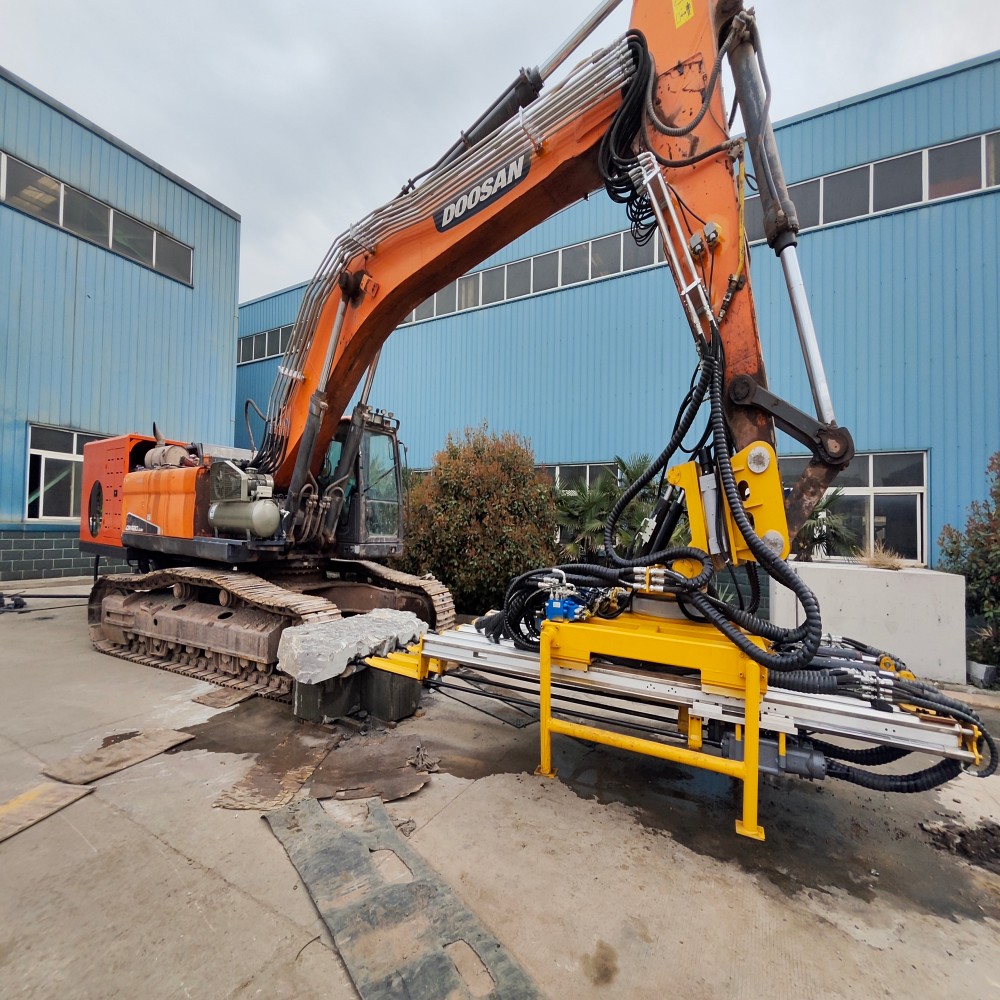
Actually, there are no shortage of other solutions on the market. Some use Drilling Rigs to drill holes and then blast, some convert excavators into excavator-drilling rigs, and some use Drilling And Splitting Machines with Ultra-high pressure Rock Splitters to slowly split. There are also many Mining Rock Splitters. Down-Hole Drilling Rigs have good efficiency for deep holes, but they don't work well in tunnels. These methods all have their own difficulties: either they are noisy and dynamic, or they are slow to move, or they become inefficient when encountering extremely hard rock. The thinking of this Anneng equipment is different. It directly confronts the rock surface and hits hard, with a high impact frequency, and the milling teeth use wear-resistant alloys, and a set of teeth can chew several thousand cubic meters. The frame has been strengthened to withstand the reverse impact vibration and doesn't need to be frequently pulled for welding.
To put it simply, in terms of value. It can handle tunnel contour adjustment, inverted arch excavation, and trench milling excavation. This machine can replace many people's work operations, reducing safety risks - the operator sits in the cab and controls remotely, without having to be close to the work face. One machine can do more work than a team, and it saves the hassle of applying for explosives.
Product features, three sufficient:
1.Impact and milling combined rock breaking, the harder the rock, the more efficient it is, twice as fast as the breaker.
2.The milling drum can be quickly replaced, and the wear parts use high wear-resistant alloys, with a low single-unit cost.
3.The entire machine is compact, with a small turning radius, and it's not difficult to maneuver in the tunnel.
Tips, two points to remember:
When the milling teeth wear down to two-thirds, replace them, don't wait until they are completely worn out, and don't damage the knife holder.
After each shift, use high-pressure water to rinse the milling drum to clean the rock powder, and the bearings can last for half a year longer.
No matter how hard the rock is, it's afraid of a serious drill. This Anneng impact milling machine is designed to save the trouble for tunnel workers. Next time you encounter hard rock, don't get stuck, just ask it first.



 Jiangsu Aneng Drilling Equipment Technology Co., Ltd.


